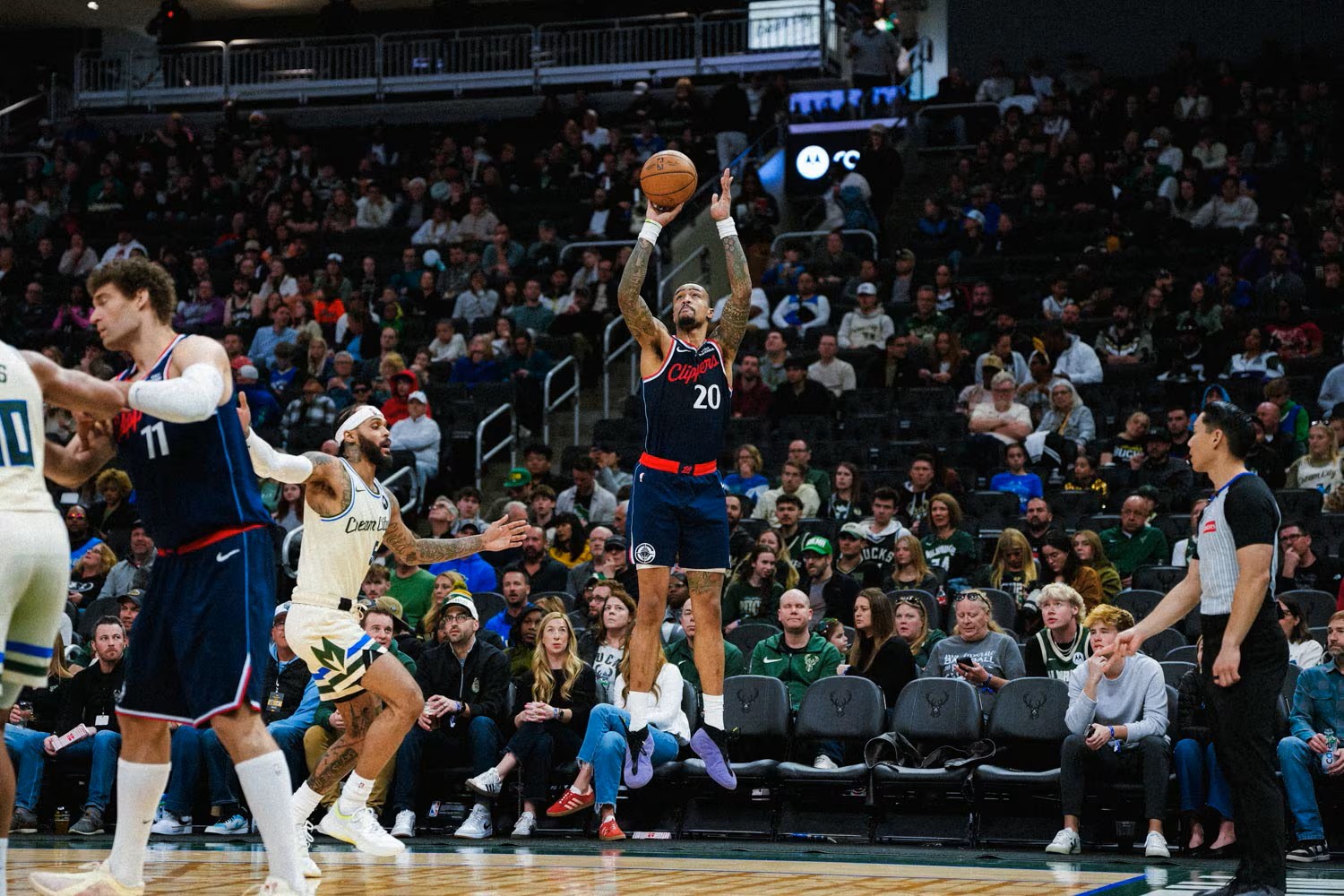
Our exit interview series on the 2026 Clippers continues with veteran forward John Collins.
Basic Information
Height: 6’9
Weight: 230 pounds
Position: Power Forward
Age: 29
Years in NBA: 9
Key Regular Season Stats (for Clippers): 13.6 points, 5.3 rebounds, 1.0 assists, 0.9 steals, 0.7 blocks, and 1.4 turnovers in 27.1 minutes per game across 69 games played (56 starts) on 55.2/40.6/76.6 (3.2 3PA, 2.2 FTA) shooting splits (64.3 True Shooting)
Expectations
John Collins was considered by most people to be the most significant acquisition the Clippers made last summer. After a series against the Nuggets in the 2025 playoffs where the Clippers looked small, weak, and unathletic, particularly in comparison to Aaron Gordon, the swap of Norm Powell for John Collins was a logical move where they upgraded all three of those weak points in their starting lineup. Or at least, that was the presumption until the Bradley Beal signing, when it became somewhat unclear if Collins would start or come off the bench. Regardless of starting status, it was expected Collins would play a major role for the Clippers as a type of player they had not had for years: a large, athletic forward that could shoot and hopefully fill in a bit as a stretch center as well.
Reality
Collins indeed came off the bench to start the season, as the Clippers went with Beal and Derrick Jones Jr. as their “other” starters next to Harden, Kawhi, and Zubac. Collins played well off the bench to start the season, scoring in double figures in eight of the Clippers’ first nine games with good efficiency and solid rebounding. However, things were thrown off for Collins, as they were for the entire team, when Beal was ruled out for the season with a hip injury. Collins was thrust into the starting lineup on November 10 and mostly stayed there the rest of the year.
The next month or so was extremely rough for both Collins and the Clippers. Collins could not make his outside shots, the spacing was clunky with him and Zubac on the floor together, his defense was inconsistent at best, and he was good for two horrible decisions per game with the ball in his hands. The Clippers floundered, and all of their offseason acquisitions seemed to be busts.
Then, towards the end of December, Collins clicked into place, and everything began to make more sense. The threes started dropping at a higher rate, the defense stepped up a level, and the rebounding ticked up. As Collins got better, so did the team, with that glorious 16-3 run coming right in line with Collins’ improved play. In fact, if you were to ask me what the main causes of the Clippers’ midseason turnaround were, I’d say first would be Kawhi Leonard’s jump from “good” to “superstar” level of play and second would be Collins figuring his place on the team out. His improvement was noticeable, and it changed how the Clippers played on a nightly basis.
Collins’ momentum carried into February, which was probably an even stronger month of play for him despite his three-point shot cooling down to normal levels. Unfortunately, he got injured towards the end of the month, missed nine games with injury, and was not quite the same the rest of the season. In fact, the Clippers removed Collins from the starting lineup in several games at the very end of the season to try to bolster their perimeter defense and ballhandling.
Ultimately, it was a highly inconsistent campaign for Collins. His January and February numbers (15 points, 6 rebounds, exceptional scoring efficiency) were in line with what fans were expecting (maybe even better), while the rest of the season his production (13 points, 5 rebounds on just decent efficiency) was below part. Collins is the player that most reflected how the Clippers’ season actually went, with a horrible close, superb middle part of the season, and disappointing close. Still, those middle months were tantalizing.
Future with Clippers
Collins is an unrestricted free agent this summer, the only major player on the Clippers’ roster in that situation (Bennedict Mathurin is a restricted free agent, everyone else has an option of some kind or is under contract for next year). Just like Mathurin, Collins’ future on the roster is therefore a bit cloudier than most of the rest of the team.
Collins is heading towards the end of his prime and the Clippers seem to be going in more of a retooling direction, which could indicate a parting of the ways. However, Steve Ballmer has said over and over again that the Clippers will not lean into being bad under his reign, and the Clippers not owning their own draft picks mean a tank is not possible. Thus, Collins’ age does not seem prohibitive for the Clippers keeping him, even on a longer-term deal.
The tricky part about unrestricted free agency, of course, is that the Clippers might not have a choice in the matter. Collins could want to play elsewhere, he could want to go to a contender, or he could find a team that is willing to pay him more than what the Clippers will pony up. All of the reporting so far is that the Clippers like Collins and that Collins likes being in LA on the team, so a mutual agreement is certainly possible. How large will that deal be? Collins was fine this year, but inconsistent, and he’s heading into the slow downslope portion of his career. I think a deal along the lines of the MLE (3 years, $48M) would make sense for both parties – I can’t imagine another team offering all that much more.
If I had to guess, I think Collins will be back on the team next year on a reasonable deal as a starter or key bench player. And, if it happens, I will be fine with it. Even though Collins can be frustrating, large forwards that can contribute on both ends are valuable, and Collins is a good fit with Darius Garland on offense.