
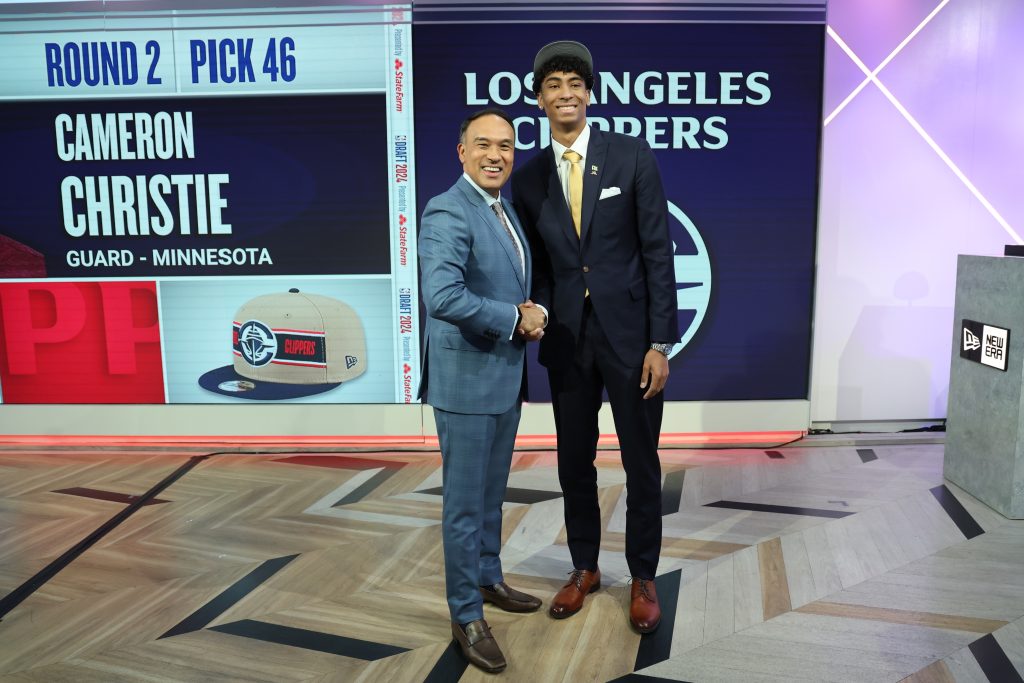
Our preview of possible Clippers’ selections with the 5th pick in the 2026 Draft continues with another point guard, Kingston Flemings.
Basic Information
Position: Point Guard
Height: 6’2.5”
Weight: 183.4 pounds
Wingspan: 6’3.5”
Age on draft day: 19.5
College: Houston
Stats: 16.1 points, 5.2 assists, 4.1 rebounds, 1.5 steals, and 1.8 turnovers in 31.7 minutes per game across 37 games played (all starts) on 47.6/38.7/84.5 shooting splits (2.9 3PA, 3.5 FTA) for 56.3 TS
Overview
Flemings sat in the 5th spot on mock draft boards for much of the college basketball season, and for good reason. While his stats were not as gaudy as Darius Acuff’s and his team wasn’t as good as Brayden Burries’, Flemings led a very good Houston team (30-7, made conference finals game, Sweet 16 of NCAA tournament) in points, assists, and steals per game as a freshman. Flemings’ well-rounded play and his intangibles kept him towards the top of the lottery for much of the season, with his slipping down to more of the 7 to 9 range happening late as Acuff and Keaton Wagler surged to close the season.
Strengths
Flemings’ best traits, much as you’d expect from a lottery point guard, are his creation abilities. Despite playing on a Houston team with poor spacing and minimal secondary creation, Flemings scored at a decent rate, scored with quite good efficiency, and had a lot of assists to minimal turnovers. His ability to penetrate the lane and finish, kick to shooters, or find big men was notable, and that was playing with a dearth of offensive talent around him. There is certainly the possibility that with NBA talent, especially shooting and big man play, Flemings will be a highly efficient scorer and playmaker.
While Flemings is a small guard, he was a good defensive player at the college level. Playing for Kelvin Sampson at Houston, you have to be solid on defense if you want to play, and Flemings certainly met that bar. You can question whether that defensive aptitude will translate to the NBA, but he was excellent at grabbing steals, posted decent rebounding stats, and generally showed competence on that end of the court. Undersized guards have been good defensively in the NBA before (Chris Paul, Kyle Lowry, Mike Conley), and while usually those players have length or weight advantages that Flemings does not, there is precedent but him to be at least an acceptable defender in the NBA.
While Flemings did not measure well physically at the Draft Combine, he did perform excellently on the athletic tests. Flemings recorded the 6th best lane agility time (5th of anyone staying in the draft), 2nd best shuttle run, and 6th best three-quarter court sprint (.01 seconds behind the leader), and had excellent standing vertical (33.5 inches, second highest of any of the lottery guards) and max vertical (40.5 inches, highest of the lottery guards). In short, he’s an athletic monster that blends speed, quickness, and vertical explosion in a combination none of the other guards in this class do. Despite his undersized frame, that athletic ability bodes well for translation to the NBA.
Weaknesses
The flip side of “well-rounded” is “jack of all trades, master of none”, which has more of a negative connotation. And, indeed, Flemings was not truly elite at almost anything in college – not scoring, playmaking, shooting, or defense. There is therefore some skepticism that someone who was not elite at skills will be able to translate a bunch of B/B+ level traits to the NBA. Sometimes those sorts of prospects succeed and sometimes they fail, so that’s not anything I’ll judge Flemings too harshly on – but he doesn’t have anything quite as obvious a strength as Mikel Brown’s three-point shooting, Wagler’s bag off the dribble, or Acuff’s sheer scoring aptitude.
Really, Flemings’ size is his biggest downside. His 6’2.5 height isn’t awful, but having only a plus 1 inch wingspan and weighing just 183 pounds is not great. If you’re going to be a smaller guard, it’s usually helpful to either be a bit heavier/stronger or have a significantly plus wingspan – all of the other guards in this mid-lottery range have those advantages on Flemings. Despite his overall basketball talent, small guards face an uphill battle in the modern NBA, with Flemings’ best size comps probably being Trae Young (much better playmaker and more dynamic shooter) and Darius Garland (was a bit of a mystery box prospect after not playing much in college). He could absolutely be a really good NBA player, but top-tier upside at his size feels unlikely, and the floor is also lower if the shot doesn’t translate.
Fit with Clippers
Not to be too redundant with previous entries in this series, but Flemings’ fit with Darius Garland is questionable at the very best. In fact, Flemings being the smallest of any of this crop of guards probably makes his fit with Garland the most tenuous, even though he’s a better defender than Brown, Acuff, or Wagler. It’s just hard to imagine the Clippers playing Garland and Flemings together at their height and weight and sustaining a positive defense when the games matter, even with Flemings’ skills on that end.
Just like Wagler and Acuff, Flemings’ fit is much easier to see if Garland was not a long-term fixture on the team – he’d slot right in as the point guard, and just like Garland would make a lot of sense next to the Clippers’ other veteran and younger players. Based on what we know about the Clippers and their thoughts on Garland, it feels unlikely to me that Flemings is the pick. That said, a lot of very smart draft people I know think Flemings is the best overall prospect of this guard group, and if the Clippers took him I’d be excited to watch him play despite the fit issues.