
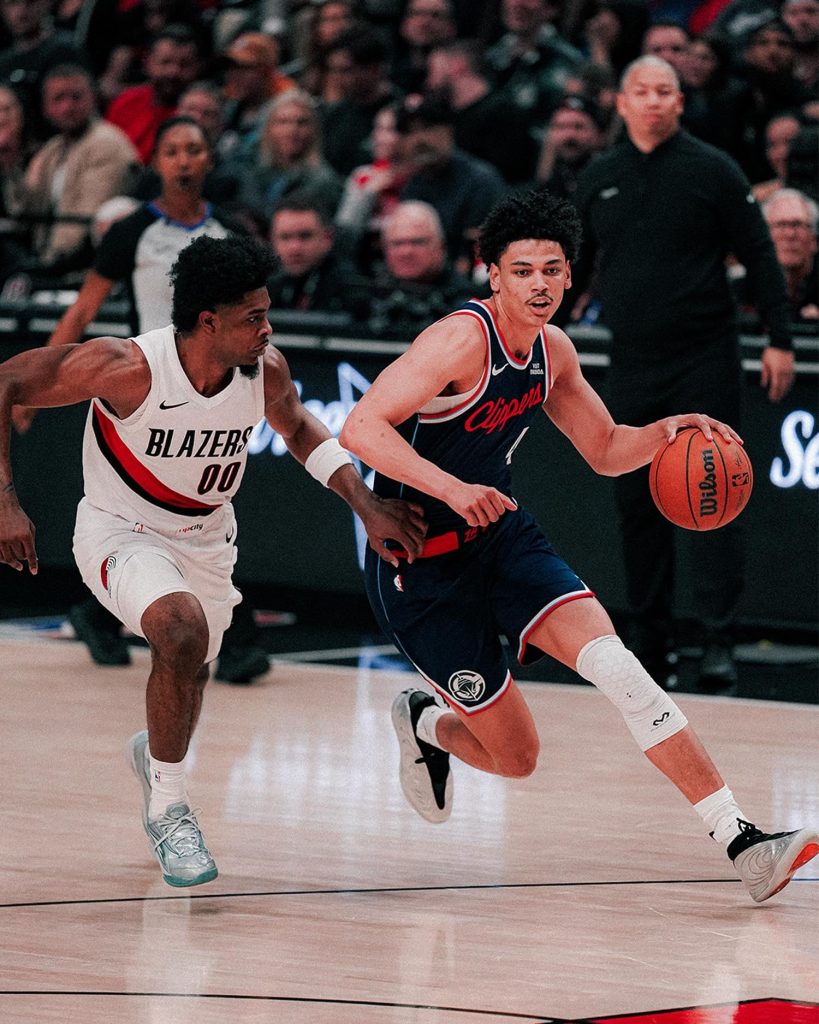
Next up in our exit interview series on the 2026 Clippers is rookie guard Kobe Sanders.
Basic Information
Height: 6’7
Weight: 207 pounds
Position: Shooting Guard/Small Forward
Age: 23 (turns 24 next week)
Years in NBA: 1
Key Regular Season Stats (for Clippers): 7.3 points, 2.3 rebounds, 1.6 assists, 0.7 steals, and 1.2 turnovers in 19.9 minutes per game across 68 games played (16 starts) on 46.6/40.8/82.6 (2.9 3PA, 1.0 FTA) shooting splits (59.7 True Shooting)
Expectations
As the 50th pick in the draft and a two-way player on a team expected to contend in the playoffs, Kobe Sanders did not have much in the way of expectations this season. Kobe was old for a rookie, and played well in the Summer League, so fans expected him to at least be a playable depth piece during periods of heavy injury, but nobody thought Kobe was going to be in the regular rotation or factor much into the Clippers’ season. When Kobe did play, the hope was for him to be competent enough at everything to not be awful, and to contribute a bit of ballhandling and scoring as a pull-up midrange shooter.
Reality
Sanders, perhaps more than any other player on the Clippers, shattered his expectations in a positive way. Kobe played garbage time minutes in the first two games, then sat out the next eight. That turned out to be the last extended stretch he didn’t play in the rest of the season.
With Bradley Beal and Kawhi Leonard out, and Chris Paul ineffective, Kobe entered the rotation on November 12 against the Nuggets and barely left it the rest of the season. Sanders had an immediate impact in his first game, nailing three of seven threes, and after a quiet second game in the rotation, had back-to-back double-digit scoring performances against the Celtics and Sixers on highly efficient shooting. Even as the rest of the team stumbled, Sanders continued to contribute solid performances, usually chipping in a handful of points, a couple of rebounds, and an assist or two on an average game.
Sanders did not leave the rotation even as the Clippers gradually got healthier and started winning games in late December. In fact, Sanders strung together perhaps his best weeks of the season in January as the Clippers went on their big winning streak, including scoring double-digit points in back-to-back games two more times with one being a noteworthy performance in a win over the Warriors. Perhaps the high note on Kobe’s entire season came on February 7, when the Clippers moved him from a two-way deal to a regular NBA contract, showing their appreciation for his play and upping his salary considerably.
Kobe’s spot in the rotation got more tenuous after the trade deadline, as Bennedict Mathurin came in and ate up a lot of minutes at the shooting guard spot, pushing Kobe to two DNP-CDs in a row on February 19 and 20. Kobe did not log more than individual DNP-CDs the rest of the way, but had a handful of games where he only played a few minutes, especially once Darius Garland also returned to the rotation. Still, down the stretch of the season, when the Clippers really needed to win games, Kobe returned to the rotation once more, this time in place of Nic Batum at the power forward spot. The fact that Kobe played minutes in those key games showed just how much trust he’d earned with the rest of the roster as well as the coaching staff.
Overall, there were rarely flashes of brilliance from Kobe, but for a rookie he was remarkably consistent, never letting bad games throw him into a funk and usually maintaining a baseline level of competence on both sides of the ball. Kobe’s three-point shooting was a particular surprise, as that was not a strength of his at the college level. He didn’t take threes at a high enough volume to be a truly dangerous threat from deep, but he shot the ball at an excellent percentage and looked confident taking contested threes. There were flashes of the confident dribble pull-up game that was Kobe’s bread and butter at the collegiate level, but for the most part he played a connector role for the Clippers – which was partially why he was a natural fill-in for Nico as Nico slipped out of the rotation. It was an encouraging rookie season, and even though there’s not a ton of upside for Kobe considering his age and lack of athleticism, he can definitely still improve in a number of facets as he ages into his mid-20s.
Future with Clippers
Kobe’s regular contract with the Clippers only runs for next season, so he doesn’t have long-term security with the team, but he’s one of the least likely Clippers to be moved in a deal. While not a future star, Kobe seems like a lock to be a rotation player in the NBA for a long time, and the Clippers’ front office and coaching staff loved having him on the team. With a small contract that’s not much use in trades, and a game that translates well to a variety of different other pieces, Kobe feels like a guy who will be on the Clippers for years to come as a supporting piece. It’s not a lock, of course – he has a long way to go to become a core piece of the team – but the Clippers have no reason to trade him and every reason to try to get him signed to a longer-term deal in the next year.